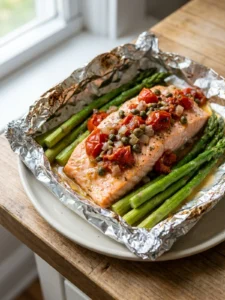
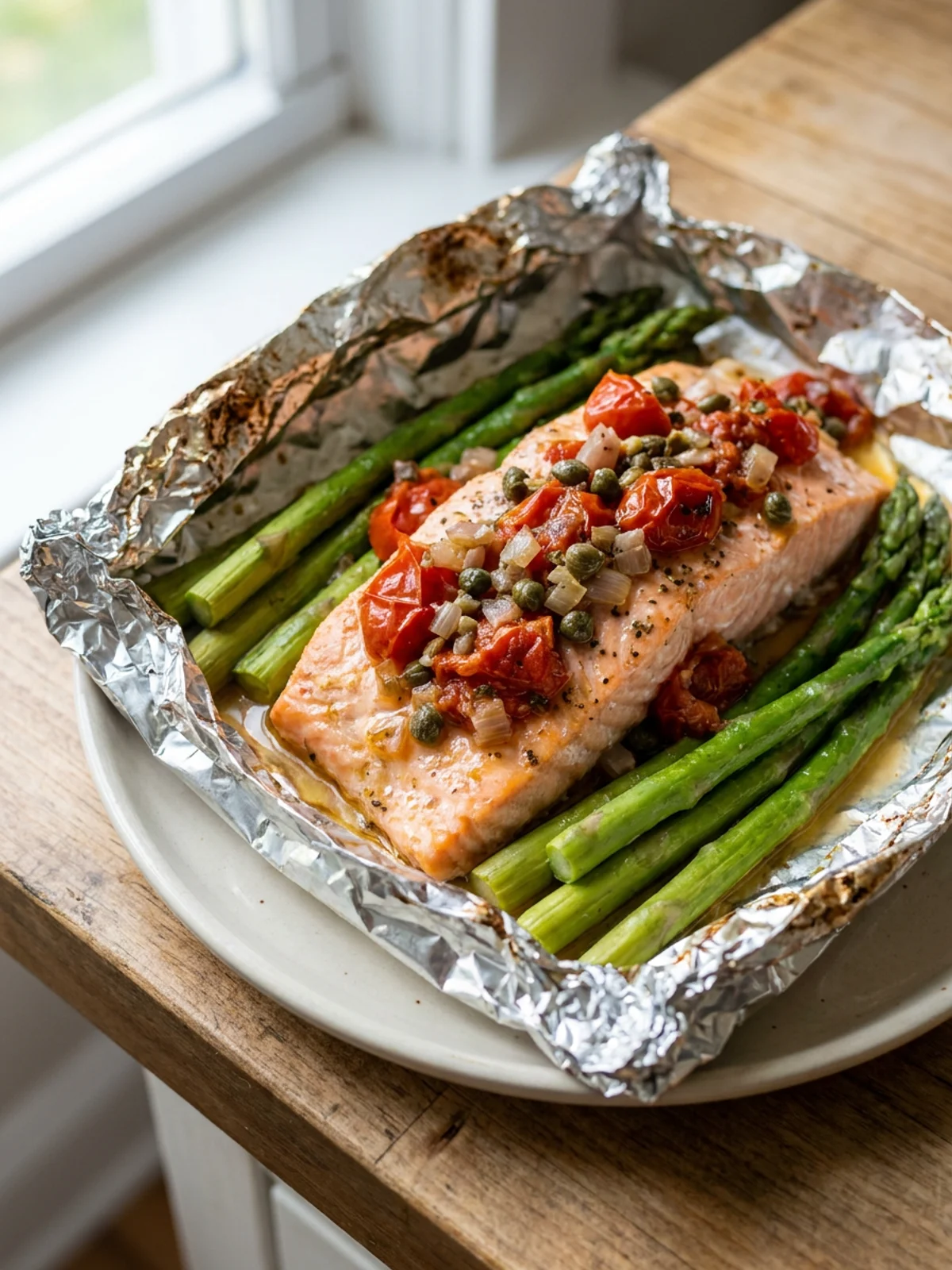
Cooking salmon and vegetables in an enclosed pouch locks in moisture and flavor. This method steams the fish gently, keeping it tender while the asparagus cooks alongside it. A topping made of diced tomatoes, shallots, and capers provides an acidic bite that balances the richness of the salmon.
Jump to:
- Why will you love <strong>Salmon Foil Packets Oven Baked</strong>?
- <strong>Salmon Foil Packets Oven Baked Ingredients</strong>
- How to Make Salmon Foil Packets Oven Baked
- Step 1: Prepare the fish and vegetables
- Step 2: Mix the topping
- Step 3: Assemble the packets
- Step 4: Fold and bake
- What to Serve with Salmon Foil Packets Oven Baked
- Helpful Tricks for Salmon Foil Packets Oven Baked
- How to Store and Freeze Salmon Foil Packets Oven Baked
- Salmon Foil Packets Oven Baked Recipe FAQs
- Can I use frozen salmon for this recipe?
- How do I know when the fish is done without opening the foil?
- Can I use fresh tomatoes instead of canned?
You can assemble these individual portions quickly on a busy evening. Cleanup is minimal since the food stays inside the wrapping. It takes about 15 minutes of chopping and mixing before the oven does the rest of the work.
Why will you love Salmon Foil Packets Oven Baked?
Baking inside a sealed pouch traps steam to cook the fish gently and prevent it from drying out.
Draining the canned tomatoes ensures the sauce stays concentrated and does not water down the vegetables.
Dividing the ingredients into individual portions makes serving straightforward and allows for customized cooking times if fillet sizes vary.
Salmon Foil Packets Oven Baked Ingredients
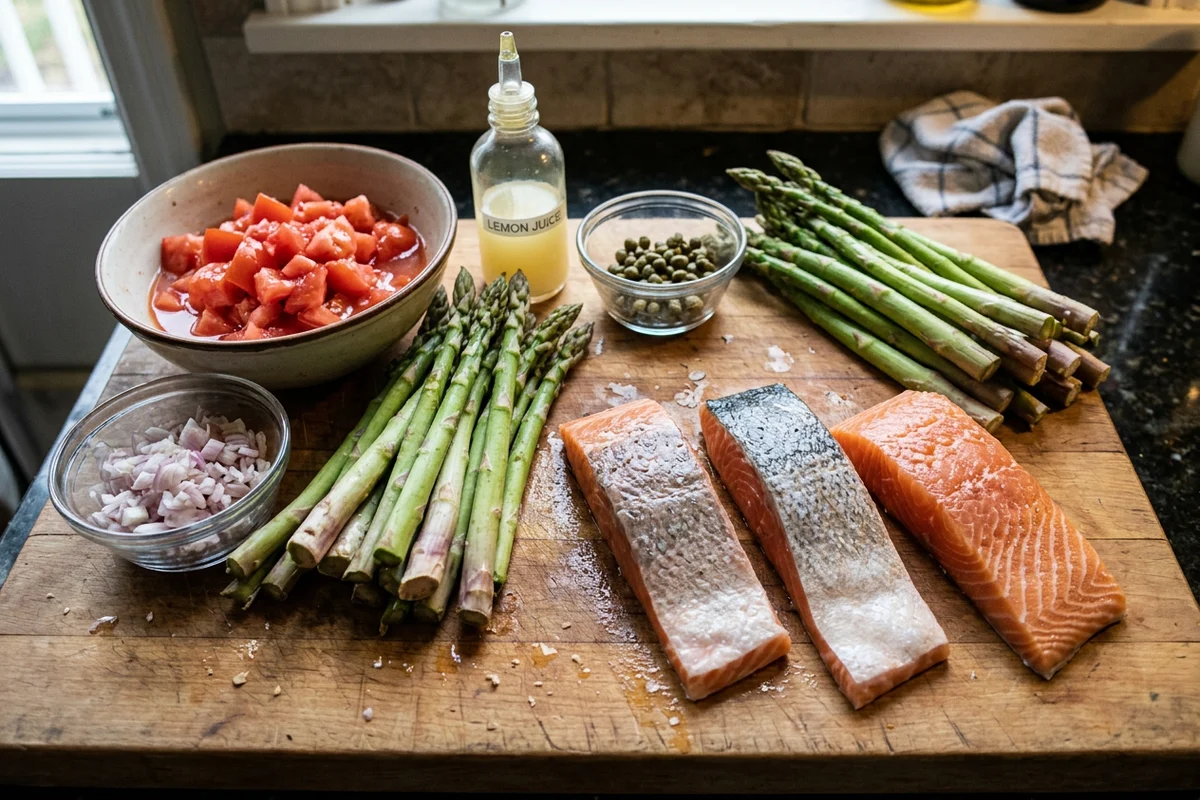
• Salmon: Look for center-cut fillets of even thickness so they cook at the same rate. Leave the skin on or take it off based on your preference.
• Diced tomatoes: Drain the canned tomatoes well to prevent the packets from getting too watery.
• Shallots: Mild red onions or yellow onions work as a substitute if shallots are unavailable.
• Asparagus: Choose medium or thin spears. Very thick asparagus might need an extra minute of cooking or a quick blanch beforehand.
• Capers: Rinse the capers if you want to reduce the overall sodium content of the dish.
Exact quantities are in the recipe card below.
How to Make Salmon Foil Packets Oven Baked
Step 1: Prepare the fish and vegetables
Start by portioning the salmon and trimming the asparagus. Brush the fish with olive oil and season it with salt and pepper. This initial seasoning ensures the salmon itself has flavor before the topping goes on.
Step 2: Mix the topping
Combine the drained diced tomatoes, chopped shallots, capers, lemon juice, olive oil, and Italian seasoning in a bowl. Add the remaining salt and pepper. Stirring these together first helps distribute the flavors evenly over each fillet.
Step 3: Assemble the packets
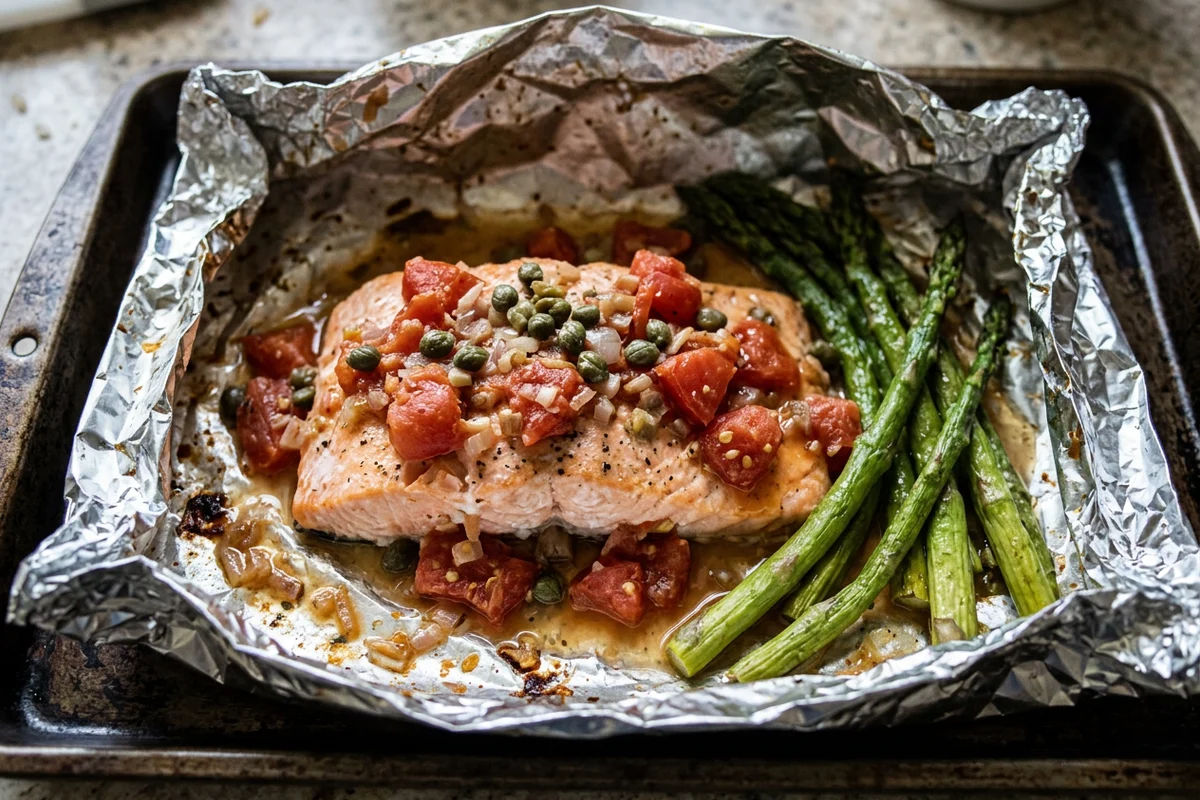
Lay out four sheets of aluminum foil. Place a seasoned salmon fillet in the middle of each sheet and nestle the asparagus pieces next to it. Spoon a generous amount of the tomato mixture directly over the fish.
Step 4: Fold and bake
Bring the edges of the foil together and fold them tightly to create a sealed pocket. Leave a small gap inside so the steam has room to circulate. Bake the packets on a sheet pan until the fish registers 145°F (63°C) on a meat thermometer.
What to Serve with Salmon Foil Packets Oven Baked
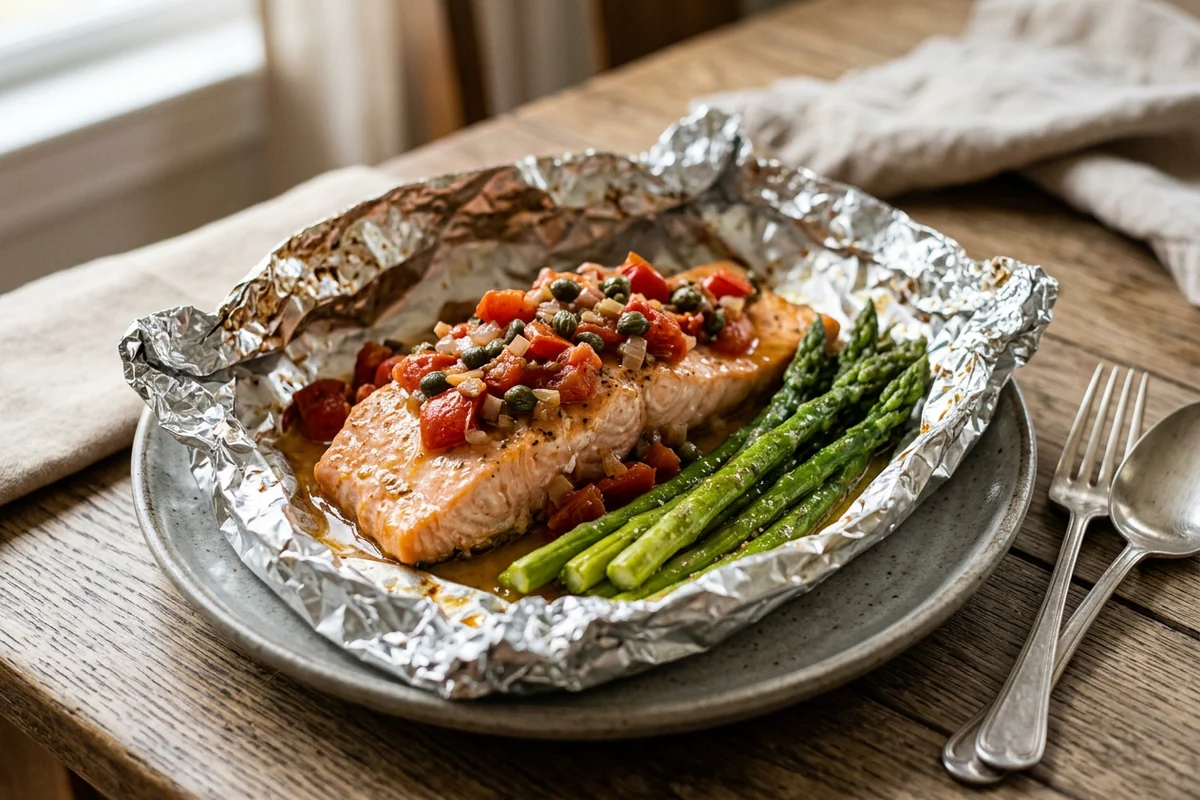
Serve this dish with a side of steamed rice, quinoa, or crusty bread to soak up the juices from the tomatoes and lemon. A crisp green salad also pairs well with the rich fish.
Helpful Tricks for Salmon Foil Packets Oven Baked
The safe internal temperature for cooked fish is 145°F (63°C). Use an instant-read thermometer in the thickest part of the fillet to check for doneness.
Parchment paper can be used instead of aluminum foil. You will need to fold the edges tightly and crimp them well to keep the steam inside.
Check the fish at the 15-minute mark if your fillets are on the thinner side.
How to Store and Freeze Salmon Foil Packets Oven Baked
Store leftover cooked salmon and vegetables in an airtight container in the refrigerator for up to 3 days. Freezing is not recommended as the asparagus will become mushy upon thawing. Reheat gently in the microwave or in a 300°F (150°C) oven until warmed through to 165°F (74°C).
Salmon Foil Packets Oven Baked Recipe FAQs
Can I use frozen salmon for this recipe?
Yes, but you must thaw the salmon completely in the refrigerator overnight before assembling the packets. Pat the fillets dry with a paper towel to remove excess moisture.
How do I know when the fish is done without opening the foil?
You will need to open one packet to check. Carefully peel back the foil to avoid the hot steam and check the thickest part of the fillet with a thermometer.
Can I use fresh tomatoes instead of canned?
Fresh diced Roma or cherry tomatoes work well. You will need about one and a half cups of chopped fresh tomatoes to replace the canned version.
Salmon Foil Packets Oven Baked
Ingredients
- 1 pound salmon cut into 4 fillets, 450 g
- 3 tablespoons olive oil divided, 45 ml
- 1 1/2 teaspoons kosher salt divided, 9 g
- 1 teaspoon black pepper divided, 2 g
- 2 tablespoons lemon juice 30 ml
- 1 can diced tomatoes drained, 14.5 oz / 411 g
- 2 shallots chopped
- 1/4 cup capers drained, 35 g
- 2 teaspoons Italian seasoning 2 g
- 1 bunch asparagus woody ends trimmed and cut into thirds
Instructions
- Preheat your oven to 400°F (200°C). Cut four pieces of aluminum foil, each about 18 by 12 inches (45 by 30 cm).
- Brush the salmon fillets with 1 tablespoon (15 ml) of olive oil. Season the fish evenly with 1 teaspoon (6 g) of salt and 1/2 teaspoon (1 g) of black pepper.
- Stir the remaining 2 tablespoons (30 ml) of olive oil, lemon juice, drained tomatoes, chopped shallots, capers, Italian seasoning, and the remaining salt and pepper together in a medium bowl.
- Place one salmon fillet in the center of each piece of foil. Arrange a quarter of the cut asparagus next to each piece of fish.
- Spoon the tomato and shallot mixture evenly over the top of each salmon fillet.
- Fold the long sides of the foil together and crease them tightly to seal. Fold the short ends up to create a closed packet, leaving a little room inside for steam to expand.
- Place the four sealed packets on a large rimmed baking sheet.
- Bake for 16 to 22 minutes. The salmon is done when it flakes easily with a fork and reaches a safe internal temperature of 145°F (63°C).
- Remove from the oven and carefully open the packets to release the hot steam before serving.